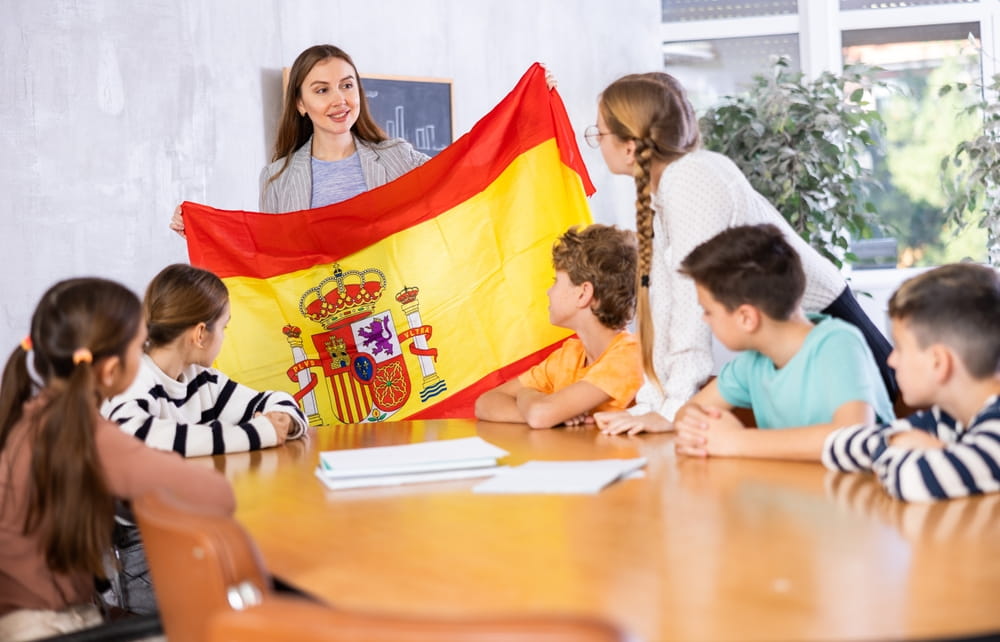
- There are three main types of schools in Spain: public, semi-private concertado and private.
- Public schools: education is free, and places are distributed through a regional system, taking into account the registration address, brothers and sisters at school, family circumstances and other criteria.
- Concertado: admission follows almost the same rules as in public schools, but in practice additional regular expenses are possible.
- Private schools: They independently set deadlines, costs and admission rules, and in popular international schools the waiting list can be a year or more.
- Documents: Usually you need the child’s passport or NIE/TIE, registration documents, birth certificate, medical documents and, if transferred, academic transcripts.
- Main rule: It is better to choose a school and check the admission dates at the same time as choosing an area to live, and not after moving.
If you have already looked at an apartment in Spain and started to figure out how your child will live here, sooner or later you will run into the same important question: how do they even enroll children in school here? The system at first glance seems simple, but dig a little deeper, and it turns out that it has its own pitfalls, regional features and deadlines that cannot be missed. We are in Alegría We constantly help families, moving to Spain, to deal with exactly this issue, so we decided to collect everything in one place.
Let’s say the main thing right away: in Spain three types of schools, and literally everything depends on which one you choose – from the amount you have to pay every month to how realistic it is to get into a particular educational institution.
Are you planning to move to Spain with your child?
It is better to check schools, availability and admission requirements at the stage of choosing an area to live. Alegría specialists will help you understand your training options and registration procedure.
Public school (colegio publico)
This is free education in its purest form. The state fully funds such schools; parents pay only for textbooks (and not always), school lunches and, possibly, excursions.
Admission here is arranged through a centralized registration system, which is organized in each region by its own Consejería de Educación. The key word here is “zone of influence” (área de influencia). Simply put, each school has its own district, and priority is given to children whose address registration (empadronamiento) is located in this zone. If you live near a school, your chances increase dramatically.
In addition to the address, when allocating seats, points are awarded for:
- presence of brothers and sisters already studying at this school;
- work of one of the parents in the same area;
- status of a large family (familia numerosa);
- disability of the child or one of the parents;
- family income level.
The application is submitted through a single form (solicitud de admisión), where you can specify several schools by priority. The application period usually opens in March, but the exact dates are set by region each year, so if you’re moving to, say, the Costa Blanca, it’s worth keeping an eye on announcements. Comunidad Valenciana, and don’t look for general Spanish deadlines – they simply don’t exist.
Documents you will need:
- application in the prescribed form;
- a copy of the child’s passport or NIE/TIE;
- certificate empadronamiento (without it you can forget about priority);
- family book (libro de familia) or birth certificate;
- medical certificate (required) and vaccination certificate (optional);
- when transferring from another school – academic certificate (boletín de notas), and if the school was not Spanish, the certificate usually needs to be apostilled and, in some cases, translated by a sworn translator.
Separately, we note: if you are not submitting documents in March, but, say, arrived in September or in the middle of the academic year, then there is no need to panic. In such cases, an extraordinary entry applies (matrícula fuera de plazo), and the school is obliged to accept you if there are any free places in the area.
Need to enroll your child in a public school?
Alegría assists families in choosing a school, preparing documents and going through the admission procedure.
Semi-private or subsidized school (colegio concertado)
Concertados are private schools that receive government funding in exchange for the fact that part of the education there is technically free. Formally, because in practice there are almost always “voluntary” contributions: for materials, for AMPA (parental association), for after-school activities, for additional classes. In total, this can amount to 50-150 euros per month, and sometimes more, depending on the school and region.
The most important thing to understand is that the process of applying to a semi-private school is almost identical to the process of applying to a public school. This is the same registration system, the same single application form, the same criteria based on points – registration, siblings, family income. The only difference is that places in popular concertado usually there are fewer, but there are many more applicants, especially if the school is religious (and the majority are) or is known for a good level of teaching.
The documents are the same as for a public school, plus sometimes the school itself asks you to fill out an additional questionnaire about your family – this is no longer a mandatory requirement of the system, but the internal practice of a particular institution.
If you are seriously considering this type of educational institution, it is better to start the process in advance and carefully monitor the dates, because there really are not enough places for everyone, and after the official registration period it is almost impossible to get there “from the street”.
Private school (colegio privado)
Everything is different here. Private schools set their own rules of the game: their own admission deadlines, their own tuition fees, their own admission requirements. The state does not interfere in this process at all.
The cost varies greatly – from a relatively affordable 300 euros per month to 1,500 and above in top international schools in Madrid or Barcelona. In resort regions, for example on the Costa Blanca, prices are usually more moderate, but international schools teaching in English or French are still significantly more expensive than their Spanish-language counterparts.
The admission process usually looks like this:
- Application directly to the school (often through the website), at any time of the year – there are no strict deadlines, as in the state system.
- Meeting the family is an interview, sometimes with the child, sometimes separately with the parents.
- Level determination test, especially if the child is transitioning from another language system. This is not an admissions exam in the usual sense, but rather a way to understand which class and with what language support to place one.
- The school’s decision and, if all is well, signing the contract and paying the deposit (matrícula), which is usually not returned.
From the documents, private schools most often ask for:
- the child’s passport and NIE/TIE (or their equivalent at the time of submission, if the documents are still being processed);
- academic transcripts for the last 1-2 years, preferably apostilled;
- medical certificate and vaccination certificate;
- a letter of recommendation from a previous school – yes, some prestigious institutions actually ask for one;
- photographs for personal use.
By the way, be prepared for the fact that the most popular international schools have waiting lists for a year or two in advance. If you are targeting a specific establishment, you should write there much in advance, and not a month before the move.
Considering a private or international school?
You can compare in advance the programs, costs, admission requirements and availability of places in schools in the desired city.
Which school should I choose?
There is no definite answer here and cannot be. Public school is a deep immersion into the Spanish language and local culture, and completely free. Concertado – a good compromise between quality and cost, but with limited space. Private – flexibility, international programs and often training in English, but you have to pay for it, sometimes a lot.
Many families, by the way, choose a public or hybrid school precisely because the child adapts and masters the Spanish language faster, and not because they cannot afford a private one. This is also worth keeping in mind.
We are in Alegría We often see the same picture: a family finds its ideal home, but remembers about school literally at the last moment. Don’t do that. Application deadlines for public and semi-private schools are tight, and good private schools fill up places long before the start of the school year. If you are looking for housing in Spain and at the same time thinking about a school for your child, write to us – we will not only find you housing in the right area, taking into account the proximity to good schools, but we will also tell you where to go and what documents to prepare in advance, so that by September you don’t have a headache about anything, and your thoughts are only around pleasant walks by the sea.
Useful materials and services
FAQ
What types of schools are there in Spain?
There are public schools in Spain (colegio público), semi-private or subsidized schools (colegio concertado) and completely private schools (colegio privado). Each type has its own rules for financing, acceptance and payment.
Do you need a residence permit to enroll in a public school?
Registration empadronamiento is of great importance in the allocation of places, since children registered in the zone of influence of a particular school receive additional points and higher priority.
When should I apply to public school?
The main application period is usually in the spring, often in March, but the exact dates are set by the Autonomous Community each year. If the family arrives later, an emergency registration procedure applies matrícula fuera de plazo.
How much does it cost to study at concertado school?
Formally, a significant part of the training is financed by the state, but in practice there may be additional contributions for materials, after-school activities, parent associations and classes. The article gives a guideline of 50-150 euros per month, sometimes more.
When to start looking for a private or international school?
The sooner the better. In popular international schools, waiting lists can last a year or two, so when choosing a specific educational institution, you should contact them long before moving.
The information is for general informational purposes only. Specific admission deadlines, list of documents and enrollment rules depend on the autonomous community and the specific school and may change. The information does not constitute legal advice. This is not a public offer.